


 USA
 Canada
 Mexico
 Brazil
 Chile
 Colombia
 Peru
 Panama
 UAE
 Saudi Arabia
 Iraq
 Turkey
 Egypt
 Afghanistan
 Israel
 Oman
 Qatar
 Yemen
 Jordan
 Nigeria
 Ghana
 Côte d’Ivoire
 Kenya
 Uganda
 Tanzania
 DR Congo
 Angola
 South Africa
 Mozambique
 Benin
 UK
 Germany
 France
 Netherlands
 Spain
 Italy
 Belgium
 Poland
 Czechia
 Sweden
 Austria
 Hungary
 Denmark
 Ireland
 Portugal
 Australia
Sea Shipping from China to Spain: FCL/LCL Rates (Q4 2026)
November 10, 2026
← All Articles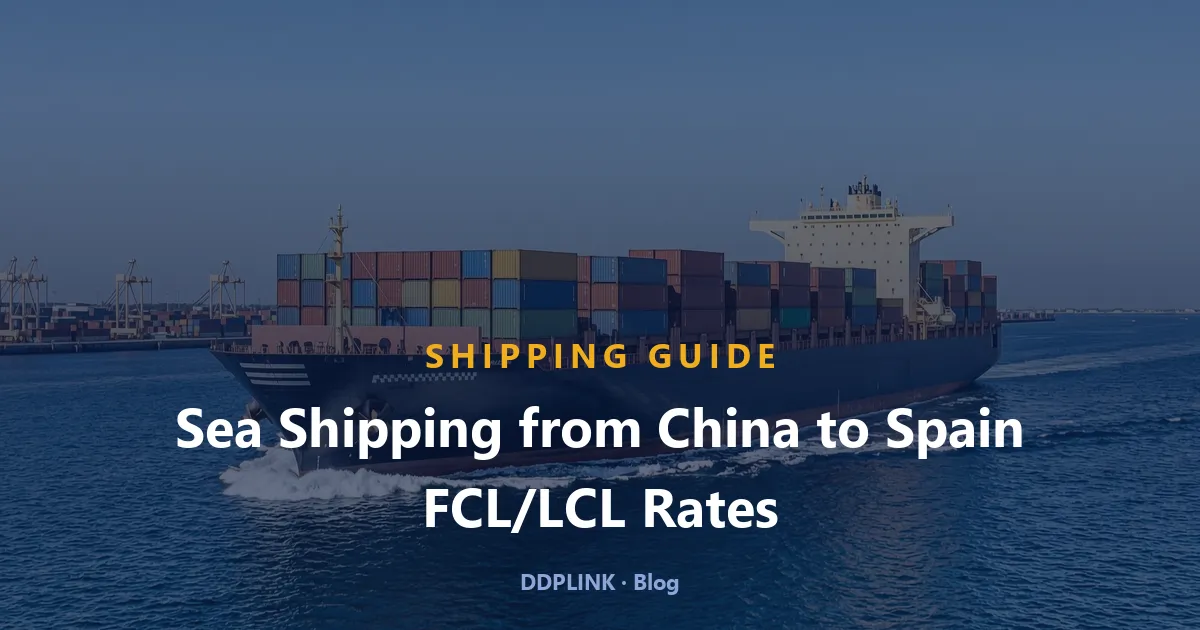

Sea shipping from China to Spain in Q4 2026: FCL and LCL rates to Valencia, Barcelona and Algeciras, transit clocks, the EU ETS surcharge and Spanish clearance.
Sea shipping from China to Spain is two products sold on the same sailing, and the gap between them decides most import budgets. Ocean freight to Valencia starts around $1,350 for a 20ft in Q4 2026; the same box delivered in Murcia with terminal charges, duty and 21% IVA settled costs close to four times that. The water leg is roughly one eighth of the invoice.
This guide is dated Q4 2026 and uses the same lane data as our shipping from China to Spain guide. It covers the port decision, FCL and LCL economics, the transit clock and the charges that arrive after the ocean rate. Every figure carries its scope; none is a quotation.
Quick Answer: FCL and LCL Rates from China to Spain (Q4 2026)
Bands below are ocean freight only — port to port, general cargo, Q4 2026 levels. Origin handling, destination charges, duty, IVA and delivery sit outside them.
| Route | Transit, port to port | 20ft FCL | 40ft FCL | LCL per CBM |
|---|---|---|---|---|
| Shanghai → Valencia | 26–35 days | $1,350–$2,150 | $2,550–$3,580 | $150–$220 |
| Ningbo → Algeciras | 28–38 days | $1,420–$2,250 | $2,650–$3,720 | $160–$230 |
| Shenzhen → Barcelona | 28–40 days | $1,480–$2,380 | $2,750–$3,880 | $170–$260 |
Three things matter more.
- A 40ft is not double a 20ft. It carries twice the volume for 1.5–1.6 times the freight, which is why light cargo ships in a 40ft high cube and dense cargo almost never does.
- The LCL column is ocean freight per CBM, not a delivered CBM. Spanish destination charges are billed per shipment plus per revenue ton, and on 3–5 CBM they add 30–60%.
- Port choice moves the rate less than product choice does. Valencia, Barcelona and Algeciras sit within a few hundred dollars of each other; a port-to-port and an all-in quote for the same box can differ by $2,000.
Our Industry Insight: Two forwarders quoting $1,600 and $2,400 for the same 20ft to Valencia are usually both telling the truth. One sells spot ocean freight with destination charges billed to the consignee; the other has THC, wharfage, the emissions surcharge and clearance inside. Ask which of the dozen lines below are inside the number you were given.
Which Spanish Port Should Your Box Discharge At?
Spain has four container gateways that take China cargo in volume, and they are not interchangeable. The delivery address picks the port.
| Port | Transit from Shanghai / Ningbo | Strongest for | What to watch |
|---|---|---|---|
| Valencia | 26–35 days | Central and eastern Spain, Madrid by rail, retail and FMCG | Terminal pressure in Q4; gate-in windows tightened |
| Barcelona | 26–35 days | Catalonia, eCommerce, distribution into southern France | Heavy relay traffic; yard congestion in peak weeks |
| Algeciras | 28–38 days | Onward routing to Latin America and West Africa; re-export | Priced as a hub; long inland haul to Madrid |
| Bilbao | 30–40 days | Northern Spain, Basque industrial cargo, Atlantic routing | Fewer direct China calls; expect one relay |
Valencia is Spain’s largest container port for China trade, and its rail link to Madrid — around 350 km — is why central Spain discharges there. Barcelona serves Catalonia and southern France. Algeciras, ninety kilometres from Gibraltar, is a relay hub first.
One charge explains most of the surprises: wharfage, known locally as T3. Each port authority computes it either as a flat amount per container or through a five-group goods tariff, and both methods are in live use, so the same box can bill differently at Valencia and Barcelona. Ask for it as a separate line.
Carrier FAK sheets reinforce it: Valencia and Barcelona normally sit in the same rate group as Genoa, Algeciras prices higher because it relays, and Bilbao often comes in lower on the 20ft.
FCL from China to Spain: Choosing the Right Equipment
Full container load is the default above roughly 11 CBM here, and the equipment decision is usually made on volume when it should be made on density.
| Equipment | Usable CBM | Typical payload ceiling | Where it wins |
|---|---|---|---|
| 20ft GP | 28–30 | 25,000–28,000 kg | Dense cargo: machinery, tiles, fittings, chemicals |
| 40ft GP | 55–58 | 26,000–27,500 kg | General cargo with balanced cube and weight |
| 40ft HQ | 65–68 | 26,000–27,000 kg | Light, bulky cargo — furniture, packaging, textiles |
| 45ft HQ | 75–78 | 25,500–26,500 kg | Very light cargo where the box is available |
Nominal volume is never usable volume: cartons do not fill corners, pallets waste height, and a 40ft of light cartons still leaves 5–8% of the cube empty.
Payload is where the arithmetic catches importers out. A 20ft is rated for about 28 tonnes, but the road leg sets the ceiling: tractor and trailer weigh 14–16 tonnes empty and Spain’s road limit is 40 tonnes gross, leaving roughly 24–25 tonnes of cargo. Dense cargo — tiles, sanitaryware, steel fittings — hits that wall first, and the fix (surcharge, two boxes, permit) costs more than planning the load.
The VGM must be submitted before loading under SOLAS rules and must be a weighing result, not an estimate — a wrong VGM is a rolled booking. Origin depot free time before gate-in is 5–7 days.
LCL from China to Spain: The Crossover Comes Earlier Than the Rule of Thumb
LCL is billed on W/M — the revenue ton, the greater of cubic volume and metric tonnage, converted at 1 CBM to 1,000 kg. Six CBM of furniture at 150 kg per CBM bills six revenue tons; six CBM of machine parts at 2,000 kg per CBM bills twelve.
The crossover is where most comparison pages go wrong. The standard advice — “LCL under 13–15 CBM, FCL above” — was written for lanes where a 20ft costs $2,500 or more. Here a 20ft to Valencia is $1,350–$2,150, so the crossover drops to roughly 9–11 CBM.
| Cargo volume | LCL at $190/CBM plus Spanish destination charges | 20ft FCL, delivered to port | Cheaper option |
|---|---|---|---|
| 3 CBM | $570 + $240 = $810 | Not viable | LCL |
| 6 CBM | $1,140 + $290 = $1,430 | $2,320 | LCL, by about $890 |
| 9 CBM | $1,710 + $340 = $2,050 | $2,320 | LCL, marginally |
| 12 CBM | $2,280 + $400 = $2,680 | $2,320 | FCL, by about $360 |
| 15 CBM | $2,850 + $460 = $3,310 | $2,320 | FCL, by about $990 |
The FCL column includes ocean freight at $1,650, origin THC and documents at $150, the emissions surcharge at $180, destination THC at $228, wharfage at $60 and B/L release at $49. LCL uses the mid-band $190/CBM plus destination CFS at $19/CBM and a fixed block of about $185. Trucking is excluded from both.
What the table cannot price is risk. LCL shares a box, is handled at two freight stations and waits for the slowest consignment before stuffing — 7–10 extra days here. One undeclared dangerous goods booking can hold all of it.
How Long Sea Freight from China to Spain Actually Takes
Port-to-port transit is the number in every rate sheet and rarely the one the buyer needs. The clock starts at the supplier’s loading dock.
| Stage | FCL | LCL |
|---|---|---|
| Booking to cargo cut-off | 5–7 days before ETD | 7–10 days before ETD |
| Origin handling | 1–2 days, gate-in to loading | 2–4 days, receiving then stuffing |
| Ocean transit | 26–38 days | 26–38 days on the water |
| Discharge and release | 2–4 days | 4–7 days, deconsolidation then clearance |
| Delivery in Spain | 1–3 days | 1–3 days |
| Realistic door to door | 32–44 days | 38–50 days |
Routing decides the ocean leg. The standard rotation to Valencia or Barcelona runs through Suez, and in November 2026 about 60% of Asia–Europe capacity is back on that routing. A service still running via the Cape of Good Hope adds 10–14 days and a few hundred dollars per 40ft in bunker cost, often without warning.
Our Industry Insight: The most common transit complaint we handle is not a slow vessel, it is a missed cut-off. A booking confirmed Thursday for a Tuesday sailing, with cargo not ready at the factory, loses the week before anyone notices — the Ningbo departure guide shows why the cut-off calendar matters more than the ETD. We ask every Spain shipper for a cargo-ready date and book the later of the two.
Inland adds its own variation: Valencia to Madrid is a day by truck and cheaper by rail on FCL, Seville or Bilbao is two days, and the Balearics add a ferry leg. Canary Islands cargo relays through Cádiz and adds roughly a week.
The Cost Lines That Arrive After the Ocean Rate
An ocean rate covers the water leg and almost nothing else. These are the lines on a Q4 2026 China–Spain sea shipment, at ranges we see on live invoices. The same numbers by air, sea and DDP sit in our China–Spain shipping cost guide.
| Line item | Typical Q4 2026 level | Billed by |
|---|---|---|
| Ocean freight, 20ft | $1,350–$2,250 | Carrier |
| BAF / fuel adjustment | Usually inside the FAK on China–Med services | Carrier |
| EU ETS surcharge | $120–$260 per 20ft; higher on 40ft | Carrier |
| Origin THC and documents | $120–$200 per container | Origin terminal and agent |
| Destination THC | €150–€260 per container | Destination terminal |
| Wharfage, T3 | €45–€65 per container | Port authority |
| B/L release and documentation | €35–€70 per shipment | Carrier or agent |
| ISPS and security fees | €10–€25 per container | Terminal |
| Customs brokerage | €60–€130 per declaration | Broker |
| Destination CFS, LCL only | €15–€22 per CBM, minimum about €60 | CFS operator |
| Storage after free time | €35–€105 per container per day, by slab | Terminal |
| Detention after free time | €30–€75 per container per day | Carrier |
The EU ETS line changed most in 2026 and is the one most often missing from comparison pages. Shipping entered the scheme on a phase-in — 40% of verified emissions in 2024, 70% in 2025, 100% from 2026 — and methane and nitrous oxide entered on 1 January 2026. Hapag-Lloyd and CMA CGM both published surcharge increases of roughly 43–45%. The rule charges 100% of emissions on intra-EU voyages but only 50% between an EU and a non-EU port, so this lane carries half the voyage emissions plus all time at berth; the European Commission’s maritime ETS guidance sets out the scope.
The surcharge is commercial, not statutory. The carrier holds the legal obligation; what reaches your invoice is a pass-through recalculated quarterly against the allowance price, which is why it belongs on the quote as its own line.
Two lines are worth naming. Several carriers on Spanish import trades bill demurrage and detention as a single clock — DD 2-in-1 — starting at cargo availability and ending when the empty is returned, so days saved at the terminal are not banked for the return leg. Free storage at Valencia is five to seven calendar days, then slabs that step up.
Spanish Clearance for Sea Cargo: DUA, EORI, Duty and 21% IVA
Spanish clearance runs through the DUA declaration, filed electronically, and an EORI number is required for every EU import. Under DDP we use our own; under FOB or CIF the importer needs one before the vessel arrives, and obtaining it is a registration step rather than a formality. That is what our DDP shipping from China service exists for.
Duty is charged on the customs value at the MFN rate for the tariff line — often 1.7–4.5% on machinery, electrical goods and furniture, higher on textiles, footwear and ceramics. Anti-dumping duties apply on top for specific origins and products, which is why an estimate built on the headline rate can be wrong by a wide margin. The EU’s Access2Markets tool gives the current measure for an HS code.
Import IVA is 21% on the customs value plus duty and is reclaimable by VAT-registered Spanish businesses — cash flow, not cost, provided the invoice names the right importer. On an $8,500 shipment that line is around $2,200, so a business that cannot deduct it has paid 16% more.
Two exceptions break the rule. The Canary Islands sit inside the EU customs union but outside the VAT area: imports pay IGIC at a general 7% instead of 21% IVA, declared separately, and the route relays through a mainland port. Ceuta and Melilla differ again. If the address is Las Palmas, the quote must say IGIC. Wood packaging needs ISPM 15 treatment and the mark; consumer goods need CE marking and Spanish labelling.
Real-Life Scenario: A Murcia importer of irrigation fittings moved a 20ft from Ningbo to Valencia in October 2026, FOB $8,500, HS line at 2.7% duty. The ocean rate was $1,650; the invoice that settled was $13,947.
| Component | Amount | Share of total |
|---|---|---|
| Goods, FOB Ningbo | $8,500 | 61.0% |
| Ocean freight, Ningbo → Valencia | $1,650 | 11.8% |
| Emissions surcharge | $180 | 1.3% |
| Origin THC and documents | $150 | 1.1% |
| Destination THC, wharfage, B/L release | $337 | 2.4% |
| Duty, 2.7% on CIF | $279 | 2.0% |
| Import IVA, 21% on CIF plus duty | $2,228 | 16.0% |
| Brokerage and delivery to Murcia | $623 | 4.5% |
| Total cash outlay | $13,947 | 100% |
Stripping the reclaimable IVA, the goods cost $11,719 to reach the warehouse — 37.9% above FOB, of which freight was 14%.
Q4 2026 Market: Suez Return, Blank Sailings and a Tighter Valencia
The market setting your December rate is moving in two directions.
| Signal | Reading, early November 2026 | Effect on China–Spain |
|---|---|---|
| Asia–Europe capacity on Suez | About 60%; 53 canal transits in the week to 5 November | Shorter transits, more effective capacity |
| Drewry composite index | $4,389 per 40ft, down 1% week on week | Softening headline |
| Rate movement over the past month | North Europe +10%, Mediterranean +23% | The Med rose faster while capacity returned |
| Announced GRIs | $1,000–$1,500 per FEU from 1 November | Carriers discounting early-November bookings anyway |
| Blank sailings | 56 of 715 sailings across weeks 45–49, an 8% cut | Roughly 9% of November capacity removed |
| Valencia terminal operations | APM Terminals cut the export gate-in window from 14 to 9 days before ETA, effective 4 November | Less margin for late cargo |
| Valencia capacity pipeline | Port authority partially suspended the MSC North Terminal concession on 5 October | New capacity arrives later than planned |
The Mediterranean figure deserves care. Rates to the Med rose 23% against 10% to North Europe even though Med services are returning to Suez fastest — Sea-Intelligence expects 70–80% of westbound Asia–Mediterranean capacity on the canal through November and December. The driver is not demand: Med hubs absorb relay cargo in both directions, and the returned loops are filling with cargo rolled from the peak. A rise on a lane whose capacity is nominally growing means the released space is absorbed elsewhere.
Our Industry Insight: The risk we plan around for December is vessel bunching, not rate direction. When Suez and Cape arrivals converge on Valencia in the same week, the terminal takes both at once and the queue moves from the anchorage to the yard. We build a two to three day buffer into gate-in and clearance dates for December arrivals and say so rather than absorbing it silently.
The Valencia notice matters practically: cutting the window from 14 days to 9 compresses factory delivery times, the terminal has said exceptions will not be granted, and a container arriving with a pending classification query sits in exactly the yard under strain.
FAQ: Sea Shipping from China to Spain
How much does it cost to ship a 20ft container from China to Spain?
Ocean freight runs $1,350–$2,380 for a 20ft to Valencia, Barcelona or Algeciras in Q4 2026, depending on origin and sailing. Delivered with terminal charges, duty and 21% IVA settled, $8,500 of goods typically lands near $14,000, of which freight is about 12%.
How long does sea shipping from China to Spain take?
FCL is 26–38 days port to port and 32–44 days door to door. LCL adds 7–10 days for consolidation and deconsolidation, giving 38–50 days. Cape routings add 10–14 days of sailing.
Is LCL or FCL cheaper from China to Spain?
LCL up to roughly 9–11 CBM. Above that a 20ft wins, because the container rate is low relative to the LCL ocean rate plus destination CFS and per-shipment charges. Dense cargo moves the crossover earlier, since LCL bills on the greater of CBM and tonnes.
Which port should I use: Valencia, Barcelona or Algeciras?
Valencia for central and eastern Spain including Madrid by rail, Barcelona for Catalonia and southern France, Algeciras for transshipment and re-export, Bilbao for the Atlantic north. Transit differences are a few days; the inland leg usually decides.
Do I pay VAT on sea freight imports into Spain?
Yes — 21% IVA on the customs value plus duty, reclaimable by VAT-registered Spanish businesses, so it is a cash-flow item. The Canary Islands are the exception: IGIC at a general 7%, declared separately.
What documents does Spanish customs need for a sea container?
Commercial invoice with accurate values and HS codes, packing list, bill of lading, an EORI number and the DUA declaration. Regulated products add CE declarations and technical files; wood packaging needs the ISPM 15 mark.
Can you ship FCL to Amazon.es fulfilment centres?
Yes, with appointment booking, correct carton and pallet labelling and compliance with the centre’s receiving window. Book the slot before the container clears — waiting after discharge turns into storage.
Conclusion: Build the Spain Number From the Charge Lines, Not the Rate
Sea shipping from China to Spain is cheap on the water and expensive on the ground. A 20ft to Valencia at $1,350–$2,150 is a real number and a useful starting point, but the invoice that settles is decided by destination THC, wharfage, the 2026 emissions surcharge, duty, 21% IVA and the inland leg — the lines that turn a $1,650 ocean rate into a $13,947 delivered container.
Pick the gateway from the delivery address, size the box on density rather than volume, compare LCL against FCL at 9–11 CBM rather than 15, and price the charge lines before you commit. Our sea freight from China service page covers how we book and consolidate the lane, and the freight cost calculator gives a first-pass figure by route and weight. Send the cargo details and the Spanish delivery postcode if you would rather start from a real number.
More articles

Air Shipping from China to Brazil: Rates & Transit
Air shipping from China to Brazil in Q4 2026: rates by weight break, routing into GRU and VCP, the DUIMP clearance clock, and air versus express at 30–150 kg.
Read Article →
Air Shipping from China to France: Rates & Transit (Q4 2026)
Air shipping from China to France in Q4 2026: rates by weight break into CDG, Lyon and Marseille, the door-to-door clock, and the French duty-and-VAT bill.
Read Article →
Air Shipping from China to Kenya: Rates & Transit
Air shipping from China to Kenya in Q4 2026: rates by weight break into Nairobi, the JKIA clearance clock, and the Kenyan taxes outside the per-kilo price.
Read Article →