


 USA
USA Canada
 Mexico
 Brazil
 UAE
UAE Saudi Arabia
 Iraq
Iraq Nigeria
 Ghana
Ghana Côte d’Ivoire
 Kenya
Kenya Uganda
 Tanzania
 DR Congo
 Angola
 South Africa
 UK
UK Germany
 France
 Netherlands
 Spain
Spain Australia
How Much Does It Cost to Ship from China to Spain? (2026 Rates)
September 29, 2026
← All Articles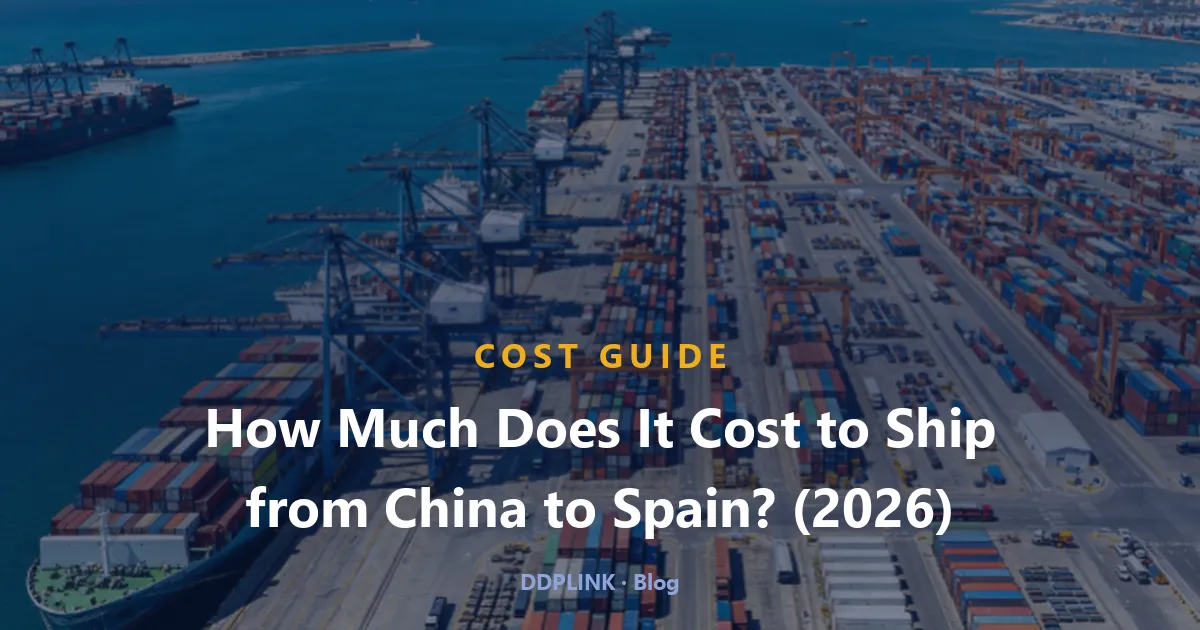

Shipping cost from China to Spain in 2026: sea FCL and LCL rates to Valencia, Barcelona and Algeciras, air and rail bands, plus the 21% IVA behind landed cost.
Shipping cost from China to Spain is quoted two ways on the same lane, and the gap is not margin — it is what the number contains. A Shanghai to Valencia sailing prices a 20ft container at $1,350–$2,150 port to port; the same box delivered near Madrid with duty and 21% IVA settled lands nearer $12,000–$14,000.
Spain sits inside the EU customs union, so Chinese-origin goods clear at MFN rates and carry import VAT from the first euro. That makes the Spanish tax stack, not the ocean rate, the line that decides what you pay. The bands below come from the same data as our shipping from China to Spain guide, followed by the cost lines that arrive after the quote: duty, 21% IVA, anti-dumping measures, packaging rules and the Canary Islands.
Quick Answer: What It Costs to Ship from China to Spain in 2026
Q4 2026 working bands for general commercial cargo. Sea and air rows are freight only: duty, IVA, terminal charges and delivery sit outside them unless the row says otherwise.
| Method | Example route | Transit | Q4 2026 band |
|---|---|---|---|
| Sea FCL 20ft | Shanghai → Valencia | 26–35 days | $1,350–$2,150 |
| Sea FCL 40ft | Shenzhen → Barcelona | 28–40 days | $2,750–$3,880 |
| Sea LCL | Ningbo → Algeciras | 28–38 days | $160–$230 per CBM |
| Air freight | Shanghai (PVG) → Madrid (MAD) | 4–7 days | $1,180–$1,560 at 100 kg; $6,900–$9,250 at 1,000 kg |
| Express courier | Shenzhen → Madrid | 4–8 days | Zone- and weight-band pricing |
| Rail freight | Yiwu / Chengdu → Madrid | 18–25 days | Between sea and air; per 40HQ or CBM |
| DDP sea, all-in | Factory → Madrid | 32–44 days | Per shipment; duty and 21% IVA inside |
| DDP air, all-in | Factory → Madrid | 6–10 days | Per chargeable kg; duty and IVA inside |
Three variables decide the row: the Chinese loading port, the Spanish gateway, and whether duty and IVA are inside the figure.
Our Industry Insight: The recurring error in China–Spain comparisons is ranking two different products — one forwarder’s all-in DDP rate set beside another’s port-to-port freight. On this lane the ocean leg is a fifth to a third of the delivered total; duty and 21% IVA are most of the rest. Ask what each figure contains.
Sea Freight Cost from China to Spain: FCL and LCL Bands
Spain’s container gateways are Valencia, Barcelona, Algeciras and Bilbao. Rates below are ocean freight only, port to port.
| Route | Transit | 20ft FCL | 40ft FCL | LCL per CBM |
|---|---|---|---|---|
| Shanghai → Valencia | 26–35 days | $1,350–$2,150 | $2,550–$3,580 | $150–$220 |
| Ningbo → Algeciras | 28–38 days | $1,420–$2,250 | $2,650–$3,720 | $160–$230 |
| Shenzhen → Barcelona | 28–40 days | $1,480–$2,380 | $2,750–$3,880 | $170–$260 |
Valencia is Spain’s largest container port and the default call for Madrid and the center. Algeciras is a relay port first, which is why its sailing count is high but its inland leg is the longest of the three. Product detail is on the sea freight from China service page; much of our Spain cargo books out of Zhejiang, and options are in the Ningbo departure guide.
20ft, 40ft or 40ft High Cube
Usable volume runs about 28–30 CBM in a 20ft, 55–58 in a 40ft and 65–68 in a 40ft high cube. A 40ft costs roughly 1.5–1.6 times the 20ft rate rather than double, so light, bulky cargo ships better in a 40ft or 40HQ. Dense cargo such as ceramics and tiles hits the road weight limit before the volume limit.
LCL: Per-CBM Rates and the Flat Charges Behind Them
LCL shares a container and bills by CBM, usually against a one-CBM minimum. The W/M rule bills the greater of volume and weight, so a dense four-CBM stack can be charged as tonnes, and the destination side adds deconsolidation and documentation charges that are flat per shipment — on a two-CBM consignment those lines can add 30–50%. The break-even against FCL sits around 13–15 CBM, so between 12 and 18 CBM ask for both prices.
Air Freight and Express Costs from China to Spain
Air cargo reaches Madrid and Barcelona in 4–8 days from Shanghai, Guangzhou or Shenzhen, and suits goods worth more than the freight. Billing uses chargeable weight, and rates fall as the consignment grows.
| Chargeable weight | Shanghai → Madrid | Effective per kg | Shenzhen → Barcelona | Effective per kg |
|---|---|---|---|---|
| 100 kg | $1,180–$1,560 | $11.80–$15.60 | $1,220–$1,620 | $12.20–$16.20 |
| 300 kg | $2,480–$3,300 | $8.27–$11.00 | $2,560–$3,420 | $8.53–$11.40 |
| 500 kg | $3,720–$4,950 | $7.44–$9.90 | $3,840–$5,100 | $7.68–$10.20 |
| 1,000 kg | $6,900–$9,250 | $6.90–$9.25 | $7,100–$9,550 | $7.10–$9.55 |
The step between brackets matters more than the airport pair: moving a 290 kg consignment up to 300 kg can produce a lower total than shipping it as quoted, because the lower break applies to the whole consignment. Service detail is on the air freight from China page.
Chargeable Weight, and Why Bulky Cargo Pays More Than It Weighs
Airlines bill the greater of actual and volumetric weight, where volumetric weight is length × width × height in centimeters divided by 6,000. A carton measuring 80 × 60 × 60 cm and weighing 8 kg bills at 48 kg. Compressing soft goods and building pallets to full height change a quote without changing the freight market, so run the dimensions through the volumetric weight calculator before requesting space.
Express courier covers the parcel end of the lane: 4–8 days door to door, priced by zone and weight band rather than one per-kilo rate, and usually the cheaper total below about 45 kg. Above roughly 100 kg, consolidated air freight wins; options are on the express courier from China page.
Rail Freight to Madrid: The Third Option Most Quotes Skip
China–Europe rail does not stop in Central Europe. The Spain-relevant build is the Yiwu–Madrid corridor, which crosses into Spain at Irún after transshipment in Poland or Germany. Our published band is 16–20 days to Central Europe and 18–25 days to Western and Southern Europe, which places rail between sea and air on both transit and price.
Rail earns its place when a container is too slow but a flight is disproportionate: mid-volume restocks, machinery that must arrive before an installation window, and seasonal goods that miss the sea cut-off. Two constraints matter. Space sells in weekly train slots, so a missed cut-off costs a full week. And corridor routings have changed more than once since 2022, so the service booked this quarter may route differently from last year’s plan. Detail is on the rail freight from China page.
The Spanish Side of the Invoice: Duty, 21% IVA and the EUR 150 Question
Spain applies the EU tariff and its own VAT rate, and the charges cascade — each line is calculated on a base that already includes the previous one.
| Charge | 2026 position | Calculated on |
|---|---|---|
| Customs duty (arancel) | MFN rates by HS code, commonly 0–12%; machinery and parts often 0–2.7%, apparel around 12% | CIF value |
| Anti-dumping or countervailing duty | Applies where a measure covers your product and origin | Customs value, on top of duty |
| Import IVA | 21% standard; 10% and 4% on listed goods | CIF plus duty plus charges to destination |
| Plastic packaging tax (IENP) | EUR 0.45 per kg of non-reusable plastic packaging | Packaging weight declared |
| Recargo de equivalencia | 5.2%, 1.4% or 0.5% for retailers in the special regime | Purchase value, non-deductible |
The IVA base includes freight and insurance, so a more expensive air shipment raises the tax as well as the transport line, and at 21% Spain’s standard rate sits at the top of the EU range.
Is the 21% Reclaimable?
For a VAT-registered Spanish business that is the importer of record, import IVA is normally recovered as input tax — a cash-flow item rather than a cost. Two conditions decide whether that holds.
The first is who files the declaration. Under an all-in DDP arrangement, where the forwarder or seller declares in its own name, the buyer may not be the importer of record and cannot deduct the input VAT — settle that before choosing DDP over DAP or CIF on a large consignment.
The second is deferral. Spanish importers that file monthly VAT returns, and are registered for monthly refunds, can use deferred import VAT (IVA a la importación diferido): the tax is entered and deducted in the same monthly self-assessment instead of being paid at customs — on a container with a $3,000 IVA line, a working-capital difference of weeks. The framework is on AEAT’s Aduanas portal.
A retailer under the recargo de equivalencia regime is in a different position: input VAT is not deductible and a 5.2% surcharge applies to goods at the standard rate, so the border taxes become a real cost.
The EUR 150 Line Is Not an Allowance
There is no duty-free allowance for commercial imports into the EU. Duty is due from the first euro, and the EUR 150 threshold does not change that — it affects the declaration route and, for distance sales to consumers, the VAT collection mechanism. The old EUR 22 VAT exemption was removed in July 2021, so commercial consignments owe import VAT whatever their value: a EUR 120 sample order still carries 21% IVA and a clearance cost, and the fixed lines can exceed the tax itself.
The European Commission has proposed removing the EUR 150 threshold as part of its customs reform, but that is still in negotiation — plan on today’s rules. Duty rates and any anti-dumping measure for your code are published in the EU’s Access2Markets and TARIC databases, and a Chinese certificate of origin buys no preference, because there is no EU–China trade agreement.
Anti-Dumping, SOIVRE and the Compliance Lines Quotes Leave Out
Freight quotes stop at the port gate. Anti-dumping duties cover a long list of Chinese-origin product groups — e-bikes, solar glass and certain steel and aluminium products among them — and where a measure applies the rate is charged on top of the normal duty, often at a level that exceeds the freight bill on the whole container. Nothing in a freight quote reflects it, because the liability depends on your HS code and the origin of the goods, not on how they travel. Two habits prevent the surprise: classify the product before booking, and re-check the measure when you repeat an order months later.
Our Industry Insight: We run every new Spain shipment’s HS code against Access2Markets before booking, and we ask the supplier for the material composition rather than the marketing name. Twice this year that check moved a shipment off the anti-dumping list because the specification differed from the invoice description; once it confirmed a measure applied, and the customer re-priced before production rather than after arrival.
Clearance itself adds $150–$400 for the broker, $120–$300 per container in terminal handling and ISPS, and $150–$400 plus one to three days if AEAT selects the box for physical inspection. SOIVRE, Spain’s foreign-trade inspection for listed consumer categories such as toys, footwear, textiles and electrical appliances, runs at the border through the Comercio Exterior inspectorate and costs a further $100–$300 per consignment with one to three days of dwell. It is not the same as CE marking: SOIVRE checks the consignment against Spanish import rules, while CE conformity is a product-level declaration that for most consumer goods is the supplier’s responsibility.
Spanish consumer law also requires product information in Spanish for goods sold to consumers in Spain, and Ley 7/2022 added two packaging obligations that sit with the seller rather than the forwarder: producer registration with annual reporting through an authorised scheme, and IENP, the excise on non-reusable plastic packaging at EUR 0.45 per kilogram declared. Both are small per unit and easy to miss at specification stage, where the choice between a shrink-wrapped pallet and a poly-bag inner pack becomes a per-kilogram charge on every kilo of plastic you import.
Door-to-Door and DDP Pricing: What the All-In Number Contains
Door-to-door means one party handles pickup at the Chinese supplier, export clearance, freight, Spanish clearance, duty and IVA settlement, and delivery to your address. The incoterm sets the boundary: DDP includes duty and IVA, DAP stops short of them, and CIF leaves the buyer with everything from the port gate onwards.
| Line | Example — 20ft, FOB Ningbo, DDP sea |
|---|---|
| Product value (FOB Ningbo) | $8,500 |
| Ocean freight plus pickup (1 × 20ft) | $1,920 |
| EU duty (about 3% on this code) | $255 |
| Import IVA at 21% on CIF plus duty | $2,242 |
| Brokerage and delivery to Madrid | Included |
| Total landed cost under DDP | $12,917 |
Freight is roughly 15% of that figure and the two tax lines about 19%: the destination side, not the sailing, decides the number.
Real-Life Scenario: A buyer near Zaragoza booked 6 CBM of irrigation fittings on an LCL rate of $180 per CBM and planned around a $1,080 freight line. Landed charges on that leg came to $1,880, and tax and clearance lines took the total to $14,266 on goods valued at $9,600 — 48.6% over FOB. Nothing on the invoice was invented: destination CFS unstuffing, a terminal minimum, three days of storage while a classification query ran, and the broker’s fee. The freight rate was right; the quote stopped at the port. We now send a destination-charge worksheet with every Spain LCL rate.
Five Levers That Move the Spain Number
| Lever | Effect | Where it applies |
|---|---|---|
| Cross 13–15 CBM into FCL | Cuts freight 15–35% and removes flat LCL charges | 12–18 CBM shipments |
| Move the bracket, not the airport | A 290 kg air consignment priced at 300 kg | Air shipments near a break |
| Check the HS code before booking | Avoids reclassification, storage and duty surprises | Every shipment |
| Clear inland where the terminal allows it | Trades port storage for a cheaper inland slot | Madrid and Zaragoza deliveries |
The DDP shipping from China service follows the same structure for Spain as elsewhere, with customs, IVA and delivery inside the agreed price.
Ports, the Inland Leg and the Canary Route
Gateway choice here is an inland-distance decision more than a freight-rate one: the ocean spread between the main ports is a few percent, while the road and rail difference is measured in hundreds of dollars per container.
| Gateway | Transit | Distance to Madrid | Best for |
|---|---|---|---|
| Valencia | 26–35 days | About 350 km, rail or road | Madrid, the center and eastern Spain |
| Barcelona | 28–40 days | About 620 km | Catalonia, eCommerce, north-eastern Spain |
| Algeciras | 28–38 days | About 650 km | Andalusia, plus transshipment to Latin America |
Madrid is served by dry ports at Coslada and Getafe, and Zaragoza’s PLAZA platform is the largest inland logistics area in southern Europe. Where the terminal arrangement allows it, clearing inland instead of at the quay shortens the storage clock: the container moves under bond and the declaration is filed at the inland office. Two facts decide whether that works — free time at the port, commonly five to seven days at Valencia and Barcelona before demurrage and detention start at roughly $60–$200 per container per day, and whether your broker is set up at both offices.
The Canary Islands, Ceuta and Melilla: Where the Rules Change
The Canary Islands are inside the EU customs territory but outside the VAT territory, so imports clear with duty under the Union Customs Code, and IGIC replaces IVA at a general rate of 7%. On top of that, AIEM applies to listed goods at rates up to 15%, a Canary-specific import tax with no mainland equivalent. Cargo to Las Palmas or Santa Cruz de Tenerife adds roughly a week to ten days to the mainland band and travels on a thinner schedule, often as a relay from a peninsular port. Ceuta and Melilla sit outside the EU customs territory and apply their own IPIS instead of IVA. Neither regime is a cheaper route to the mainland: moving goods from the Canaries, Ceuta or Melilla onto the peninsula has its own documentation, and shipments from peninsular Spain to the Canaries are treated as exports for IVA purposes.
FAQ: China to Spain Shipping Costs
How much does it cost to ship a container from China to Spain?
Q4 2026 ocean freight runs $1,350–$2,380 for a 20ft and $2,550–$3,880 for a 40ft, port to port. Add terminal handling, clearance, duty and 21% IVA for the delivered figure — $12,917 all-in on the 20ft example.
How much does it cost to ship from China to Spain per kilogram by air?
Effective rates fall with consignment size: $11.80–$15.60 per kg at a 100 kg booking from Shanghai to Madrid, $8.27–$11.00 at 300 kg and $6.90–$9.25 at 1,000 kg. Under DDP the price is quoted all-in per chargeable kilogram.
How long does shipping from China to Spain take?
Air and express take 4–8 days, rail 18–25 days, sea 26–40 days port to port, and DDP sea 32–44 days door to door. Add one to five days after discharge for terminal release and clearance.
Do I pay duty and VAT when importing from China to Spain?
Yes. Duty follows the HS code at MFN rates, commonly 0–12%, and 21% import IVA applies to the CIF value plus duty. There is no duty-free allowance for commercial consignments, and no EU–China agreement lowers the rate.
Is there a EUR 150 exemption for imports into Spain?
No. The EUR 150 line governs the declaration route and the VAT collection mechanism for distance sales, not the liability: duty is due from the first euro, and the old EUR 22 VAT exemption was removed in July 2021.
Can I reclaim the 21% import IVA, and do the Canary Islands work the same way?
Import IVA is normally recovered as input tax if your business is VAT-registered and is the importer of record, and monthly filers can defer it so it is not paid at the border; under DDP the declaration may be in the forwarder’s name, which can block the reclaim. The Canaries differ: IGIC at 7% replaces IVA, AIEM applies to listed goods.
Conclusion: Building a Spain Number You Can Budget Against
Shipping cost from China to Spain is two figures. The first is a freight band set by your loading port, Spanish gateway and mode. The second is a destination stack of duty, 21% IVA, clearance, packaging obligations and inland delivery that can equal or exceed the freight line — and that moves with your HS code and your VAT position.
Put a date on every rate, and check the anti-dumping position on the code before you book rather than after the container sails. Send us the goods description, HS code, volume or weight and the delivery city, and we will return a line-by-line figure showing what sits inside it, or run a first estimate on the freight cost calculator.
More articles
Air Shipping from China to Kuwait: 2026 Rates, Transit & Clearance
Air shipping from China to Kuwait in Q4 2026: rates by weight break into KWI, transit via Dubai and Doha, KUCAS clearance, and 5% duty with no VAT.
Read Article →
Air Shipping from China to Nigeria: 2026 Rates & Transit
Air shipping from China to Nigeria in Q4 2026: rate bands into Lagos, Abuja and Kano, chargeable weight, the Form M and SONCAP clock, and what happens at MMIA.
Read Article →
Air Shipping from China to South Africa: 2026 Rates, Transit Times & Clearance
Air shipping from China to South Africa in 2026: rates by weight break, transit to Johannesburg, Cape Town and Durban, and the SARS duty and 15% VAT stack.
Read Article →