


 USA
 Canada
 Mexico
 Brazil
 Chile
 Colombia
 Peru
 Panama
 UAE
 Saudi Arabia
 Iraq
 Turkey
 Egypt
 Afghanistan
 Israel
 Oman
 Qatar
 Yemen
 Jordan
 Nigeria
 Ghana
 Côte d’Ivoire
 Kenya
 Uganda
 Tanzania
 DR Congo
 Angola
 South Africa
 Mozambique
 Benin
 UK
 Germany
 France
 Netherlands
 Spain
 Italy
 Belgium
 Poland
 Czechia
 Sweden
 Austria
 Hungary
 Denmark
 Ireland
 Portugal
 Australia
Air Shipping from China to France: Rates & Transit (Q4 2026)
November 11, 2026
← All Articles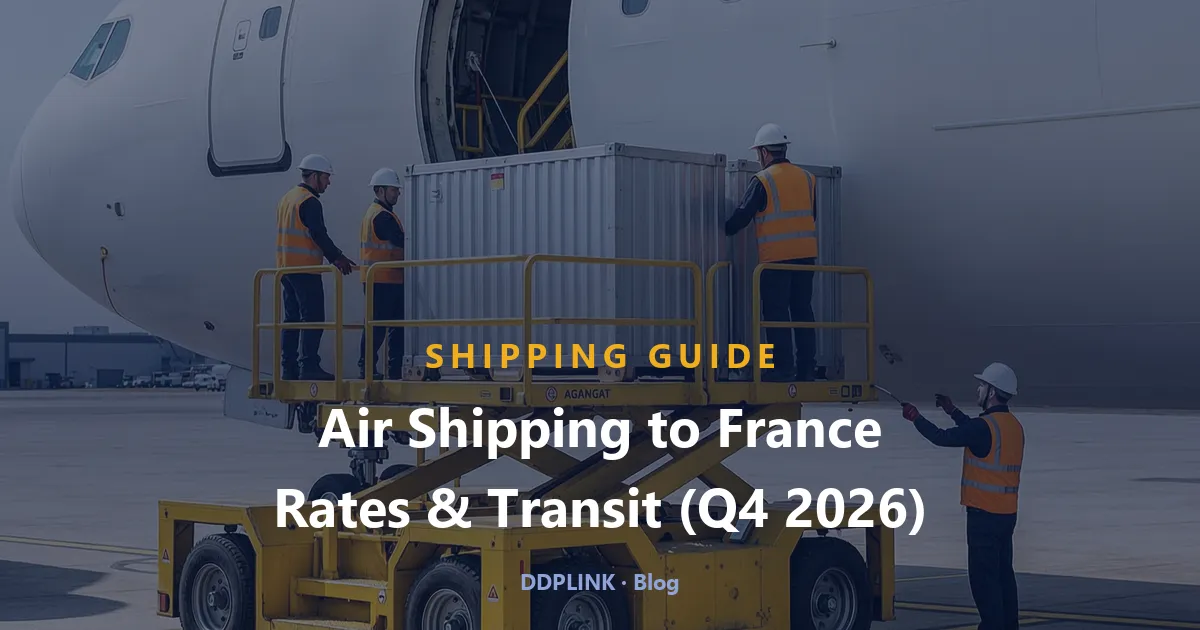

Air shipping from China to France in Q4 2026: rates by weight break into CDG, Lyon and Marseille, the door-to-door clock, and the French duty-and-VAT bill.
Air shipping from China to France is a three-to-seven day product on the Shanghai–Paris lane, and a conversation about which kilogram you are paying for. The flight is the easy part. What decides the invoice is the weight break you book at, the pallet build your cartons allow, and the French duty-and-VAT line that arrives after the aircraft does.
This guide prices the lane by weight break for Q4 2026, separates the charges that actually bill on a China–France air waybill, compares the three French gateways, and sets out the import bill after the 2026 low-value reform. For the destination picture first, start with shipping from China to France.
Quick Answer: Air Shipping from China to France (Q4 2026)
| Question | Short answer (Q4 2026) | Caliber |
|---|---|---|
| Air freight cost | $3.40–$7.20 per kg for general cargo | Per-kilo reference, not a booked total |
| Airport transit | 3–6 days Shanghai (PVG) to Paris (CDG) | After airline acceptance, general cargo |
| Door to door under DDP air | 6–9 days | Clearance, duty, VAT and delivery inside the price by agreement |
| Billed on | Chargeable weight, the greater of actual and volumetric weight in cm ÷ 6,000 | One cubic metre is 166.67 kg |
| Main gateway | Paris CDG, with Lyon for the south-east | CDG handled about 1.92 million tonnes in 2025 |
| At import | Duty by HS line, 20% VAT, EORI plus a French VAT number | VAT is autoliquidated on the CA3 return, not paid at the border |
Air Freight Rates from China to France by Weight Break
Our published lane bands, cut off in early November 2026 for general cargo on scheduled capacity. They are planning bands, not a price list: the confirmed rate follows the space booked, the surcharges on the flight date, and the weight measured at origin.
| Route | Transit | 100 kg | 300 kg | 500 kg | 1,000 kg |
|---|---|---|---|---|---|
| Shanghai (PVG) → Paris (CDG) | 3–6 days | $1,120–$1,480 | $2,360–$3,140 | $3,540–$4,700 | $6,600–$8,800 |
| Shenzhen (SZX) → Paris (CDG) | 3–7 days | $1,140–$1,500 | $2,400–$3,200 | $3,600–$4,780 | $6,700–$8,950 |
| Guangzhou (CAN) → Lyon (LYS) | 4–7 days | $1,160–$1,540 | $2,440–$3,260 | $3,660–$4,880 | $6,800–$9,100 |
Read the table as a curve rather than four prices. On PVG–CDG the same kilogram costs $11.20–$14.80 at a 100 kg booking and $6.60–$8.80 at 1,000 kg — a 41% drop driven by the fixed block of charges on every air waybill, not by negotiating. Most of this cargo starts within an hour of Pudong, and the Shipping from Shanghai page covers pickup, export declaration and the airport cut-off from that side.
Our Industry Insight: The weight break is the only line a shipper can move without asking anyone for a favour. 280 kg of cargo prices at $3,136–$4,144 inside the 100 kg break. Declare it as a 300 kg booking and the band is $2,360–$3,140, with the airline billing 300 kg either way. At the bottom of the range you break even because you pay for 20 kg you do not have; at the top you keep roughly $1,000. We run that arithmetic before we quote.
What Actually Bills on a China–France Air Waybill
A quote showing only “USD per kg” is incomplete on this lane.
| Line | What it covers | Who bills it | Inside our DDP air quote |
|---|---|---|---|
| Base rate | Airport-to-airport carriage at your weight break | Airline, through us | Yes |
| Fuel and security surcharge | Levied on chargeable weight; moves with fuel and security costs | Airline | Yes, priced at the flight date |
| Origin charges | Pickup, warehouse handling, export declaration, screening, weighing, AWB | Us, in China | Yes |
| Destination handling | Terminal handling and storage in the CDG cargo area | Terminal operator | Storage beyond the free window is on the consignee |
| Clearance, duty, VAT, delivery | Brokerage, DELTA entry, duty, VAT, trucking to the address | French agent and importer of record | Yes, under DDP by agreement |
The base rate is the line importers underrate. Air bills the space you occupy, not the mass you ship: volumetric weight is length × width × height in centimetres ÷ 6,000, and the airline charges whichever figure is higher. Dense cargo pays on the scale; bulky cargo pays for the air it displaces. Our Air Freight from China page carries the same divisor and the breaks we book against.
| Carton | Dimensions (cm) | Actual weight | Volumetric weight | Chargeable weight |
|---|---|---|---|---|
| Dense cargo (hardware) | 60 × 40 × 40 | 32 kg | 16 kg | 32 kg |
| Mixed cargo (apparel) | 60 × 40 × 50 | 15 kg | 20 kg | 20 kg |
| Bulky cargo (cushions) | 80 × 60 × 60 | 8 kg | 48 kg | 48 kg |
Measurement happens twice — in your supplier’s warehouse and again at the airport, per piece. A PMC pallet covers 2.44 by 3.18 metres, so an overhanging carton is charged on the pallet footprint rather than its own, and a half-built pallet pays for air it never used. We ask for dimensions with the proforma invoice, because a re-measure at the airport is what turns a quote into a different invoice.
CDG, Lyon or Marseille: Picking the French Gateway
France has one airport that matters for freighter capacity and two that matter for the last truck leg. The choice is usually arithmetic, not preference.
| Gateway | Freighter capacity | Planning transit | Best for |
|---|---|---|---|
| Paris CDG | Deep, including belly hold on passenger flights | 3–6 days | National distribution, fashion, electronics, eCommerce |
| Lyon-Saint-Exupéry (LYS) | Regional and express, limited heavy freighter | 4–7 days | Auvergne-Rhône-Alpes, eastern and southern France |
| Marseille Provence (MRS) | Thin freighter capacity, mostly belly and road feed | 5–8 days | Mediterranean France, when CDG space is tight |
| CDG plus truck | CDG capacity, then 4–8 hours on the road | 5–8 days | Southern deliveries when a direct LYS rate does not exist |
CDG handled about 1.92 million tonnes of freight and mail in 2025 — a couple of percentage points behind Frankfurt, and roughly half in aircraft bellies. That belly share keeps Paris liquid in peak weeks: the capacity arrives on passenger flights that operate whether or not your cargo shows up. FedEx runs its main European express hub at CDG; Air France-KLM Martinair Cargo and the Chinese carriers carry the freighter share.
Our Industry Insight: Rankings between CDG and Frankfurt flip on a couple of percent and mean nothing at booking time. What matters is which carrier has traffic rights and space on the week you need. In the first two weeks of December, a confirmed Wednesday allotment on PVG–CDG is worth more than a cheaper rate that ships “next available”.
Transit Time from China to France, Door to Door
Door-to-door is a chain of four clocks, and only one of them is the flight.
| Stage | Typical time | What moves it |
|---|---|---|
| Pickup and consolidation in China | 1–2 days | Supplier readiness, distance to PVG, SZX or CAN |
| Export declaration, screening, build | Same day to 1 day | Documents complete, secure-chain status, DG review |
| Flight | About 12 hours PVG–CDG | Routing; direct versus one stop |
| Import release in France | 1–2 days | ENS filed, HS code agreed, VAT number valid |
| Delivery in France | 1–2 days | Paris overnight, Lyon and Marseille next day, rural plus a day |
Booking the Week You Need (Q4 2026 into Q1 2027)
Capacity from China tightens from September through the first half of December, and the pre-holiday cut-off is the most common reason a shipment misses its date. Two French spikes sit on top: the February and September fashion weeks, when apparel capacity around Paris is absorbed weeks ahead, and the January soldes, which need stock in a French warehouse by early December. Book three to four weeks ahead for both and treat the booking as a reservation with a named flight, not a rate agreement. Chinese New Year then closes factories for two weeks around late January 2027, pushing the first Q1 departures into the second half of February.
The French Import Bill: Duty, 20% VAT and the 2026 Low-Value Reform
The freight is settled before the aircraft lands. The tax and duty side is settled after, and in 2026 that side changed.
| Line | Rate (Q4 2026) | Charged on | Note |
|---|---|---|---|
| Customs duty | By HS line — 12% on a typical apparel line | CIF value: goods + freight + insurance | Duty is charged on the freight too |
| Import VAT | 20% standard rate | CIF value plus duty | Reclaimable when you are VAT-registered in France |
| Temporary low-value duty | €3 per item category | Consignments up to €150 | Since 1 July 2026, replacing the abolished relief |
| Union handling fee | €2 per item | Distance-sale consignments | Applies from 1 November 2026 |
| EORI and French VAT number | No charge, but mandatory | Every commercial entry | VAT number goes on the entry, code 1008 in DELTA G or X Import |
| Brokerage | Quoted per entry | Per declaration | Inside a DDP price; separate under DAP |
Two are new and routinely missed in quotes written before the summer. The €150 duty relief was abolished on 1 July 2026, and until the EU customs data hub goes live a flat €3 duty applies per item category on consignments up to €150 — per category, not per parcel. The €2 Union handling fee arrived on 1 November 2026. Neither touches a 320 kg B2B pallet; both hit the small DDP parcels and marketplace restocks, and the Commission sets out the reform on its EU customs reform page.
VAT is the line that surprises sellers. Since 1 January 2022, French import VAT is autoliquidated — declared and deducted on the same CA3 return, with no cash paid at the border — for any business holding a valid French intra-EU VAT number. The 20% no longer sits in your cash flow for a month, but the declaration is not optional: an entry filed without the number cannot be autoliquidated. The customs service sets out the mechanics, including the 1008 and FR7 codes, on its autoliquidation page.
Worked Landed Cost: 320 kg of Fashion Accessories
One pallet, one HS line, one address in Paris. The arithmetic below uses the low end of our 300 kg band and a 12% apparel duty rate.
| Cost component | Amount | Basis |
|---|---|---|
| Goods, FOB Shanghai | $9,600 | 320 kg at $30 per kg |
| Air freight, 300 kg break | $2,360 | Published band, origin charges included |
| Insurance | $36 | 0.3% of goods plus freight |
| Customs value (CIF) | $11,996 | Goods, freight and insurance |
| Duty at 12% | $1,440 | On the CIF value |
| Import VAT at 20% | $2,687 | On CIF plus duty |
| Brokerage and delivery in Paris | $440 | One entry, one address |
| Total, VAT paid at entry | $16,563 | $51.76 per kg |
| Total, VAT autoliquidated | $13,876 | $43.36 per kg on the CA3 return |
The freight is 14% of that invoice; duty and VAT are 25%. A seller who negotiates $200 off the air rate and ignores the HS code is arguing about the smallest line in the file — an apparel line classified two digits away can move the duty by more than the freight negotiation is worth.
Under DDP Shipping from China those lines sit inside one per-kilo price, with the VAT itemised separately so a French buyer can see what is reclaimable. Under DAP you keep the freight and hand the import file to your own broker — usually the better structure once you have a French entity with its own EORI and VAT number.
Why Cargo Sits at CDG: ICS2, ACC3 and the Secure Chain
Most air cargo does not sit in France because of freight. It sits because a filing was wrong or a security status was missing, and both are decided before the aircraft loads in China.
ICS2 and the Entry Summary Declaration
Every consignment entering the EU needs a valid ENS in ICS2, and for air cargo a minimum dataset must be filed before loading. France retired old national ICS(1) filings for road and rail on 1 January 2026, and since 1 June 2026 every consignment by any mode needs an ENS in ICS2 or via NCTS Phase 6 where that applies. On a China–France air shipment the effect is simple: the goods description and six-digit HS code have to be right at origin, because a vague line such as “spare parts” invites a do-not-load response that arrives after your cargo is at the terminal. The Commission’s ICS2 page lists the data sets by mode.
ACC3, RA3 and Who Screens Your Cargo
Air cargo bound for the EU moves through a validated secure supply chain. The carrier must be designated ACC3 for each third-country airport it serves, and the forwarder handling your cargo in China needs RA3 or KC3 status to be part of that chain. Otherwise the cargo is screened by or on behalf of the ACC3 before loading — legal, but slower and charged for. This is not fixable at the airport: validation is an on-site audit on a multi-year cycle, which makes the forwarder you choose in China a compliance decision as much as a rate one.
Real-Life Scenario: A 640 kg shipment of LED fixtures from Zhongshan was booked on a Friday PVG–CDG freighter with an invoice describing the goods as “lighting parts” and no HS code. The ENS went in with the same wording, customs risk analysis returned a do-not-load, and the cargo was pulled from the build an hour before cut-off. The re-filing took a day, the next freighter slot was Monday, and the French buyer’s installer was already booked for the Saturday. Nothing was wrong with the freight rate. The paperwork cost four days on a shipment that had been quoted at three to six.
Air, Express, Rail or Sea: Where the Breaks Fall
The four modes overlap in weight range but not in economics. The usual break points are around 45 kg between express and air, and roughly 1.5 to 2 CBM between air and sea once the cargo is dense enough to fill a container.
| Mode | Best for | Planning transit | Priced by | Practical entry point |
|---|---|---|---|---|
| Express courier | Samples, documents, first units | 3–7 days | USD per chargeable kg, banded | Up to about 45 kg |
| Air freight | Urgent commercial cargo, launch stock, restocks | 3–7 days | USD per chargeable kg, by weight break | From about 45–100 kg |
| Air under DDP | Sellers who want duty, VAT and delivery in one price | 6–9 days | USD per chargeable kg, all-in | From about 22 kg on some lanes |
| Rail | Planned replenishment with a three-week window | 18–25 days to France | Per container or per CBM | From 1 CBM |
| Sea LCL | Heavy or bulky cargo with no deadline | 25–38 days | USD per CBM | From 1 CBM |
The comparison that matters is cost per week saved, not cost per kilogram. Air at $6.60–$8.80 per kg against sea LCL at $150–$220 per CBM is a five-to-eightfold difference in unit cost and a 25-day difference in arrival — worth paying only when the margin or a launch date covers it. Our shipping cost from China to France guide breaks the sea side down by port.
FAQ: Air Shipping from China to France
How much does air shipping from China to France cost per kg?
General cargo runs $3.40–$7.20 per kilogram as a market reference in Q4 2026. On our published PVG–CDG bands that means $11.20–$14.80 per kg at a 100 kg booking and $6.60–$8.80 at 1,000 kg, because the fixed charges are spread over more kilos.
How long does air freight take from China to Paris?
Three to six days door to door on PVG–CDG, of which about 12 hours is flight time. Add two to four days in peak weeks if the cargo needs screening or a space roll.
Is air freight cheaper than sea freight to France?
No — sea LCL at $150–$220 per CBM is far cheaper per unit for dense cargo. Air wins only when the delay costs more than the premium: launch stock, production-line components, fashion drops and restocks.
What documents does French customs need for air cargo?
A commercial invoice with a six-digit HS code and accurate values, a packing list, the air waybill, an EORI number, a valid French intra-EU VAT number for autoliquidation, and CE declarations or French labelling evidence for regulated consumer goods.
Do you offer DDP air shipping to France?
Yes. DDP air is 6–9 days door to door, with pickup, freight, DELTA clearance, duty, VAT and delivery inside one per-kilo price, and the VAT shown as a separate line on the invoice.
Can I ship lithium batteries by air to France?
On carriers that accept battery cargo, with a UN38.3 test report, a safety data sheet and the correct packing instruction. Tell us the battery type at the quote stage — the airline approval is part of the booking, not an airport formality.
Should I use CDG, Lyon or Marseille for southern France?
Compare the truck leg before the airport. A direct LYS rate that is $0.60 per kg higher usually beats a cheaper CDG arrival plus six hours of road, but only when LYS has freighter space on your week — often it does not.
Why does my quote show a €2 handling fee?
Because the EU’s Union handling fee applies from 1 November 2026 to distance-sale consignments, at €2 per item, alongside the temporary €3 duty per item category on consignments up to €150. Neither applies to a consolidated B2B pallet.
Conclusion: Four Numbers Before You Book
Four numbers decide a China–France air shipment: the chargeable weight you will actually be billed for, the weight break you book into, the HS code behind your duty rate, and the date your French VAT number was last validated. Everything else — carrier, routing, gateway — is negotiable around those four.
Run the lane through the Freight Cost Calculator to see where your cargo sits against the breaks, then send us the carton dimensions, the HS code and the delivery postcode. We will come back with a booked rate and a landed cost on the same page, so the number you approve is the number you pay.
More articles

Air Shipping from China to Brazil: Rates & Transit
Air shipping from China to Brazil in Q4 2026: rates by weight break, routing into GRU and VCP, the DUIMP clearance clock, and air versus express at 30–150 kg.
Read Article →
Air Shipping from China to Kenya: Rates & Transit
Air shipping from China to Kenya in Q4 2026: rates by weight break into Nairobi, the JKIA clearance clock, and the Kenyan taxes outside the per-kilo price.
Read Article →
Air Shipping from China to Kuwait: 2026 Rates, Transit & Clearance
Air shipping from China to Kuwait in Q4 2026: rates by weight break into KWI, transit via Dubai and Doha, KUCAS clearance, and 5% duty with no VAT.
Read Article →