


 USA
USA Canada
 Mexico
 Brazil
 UAE
UAE Saudi Arabia
 Iraq
Iraq Nigeria
 Ghana
Ghana Côte d’Ivoire
 Kenya
Kenya Uganda
 Tanzania
 DR Congo
 Angola
 South Africa
 UK
UK Germany
 France
 Netherlands
 Spain
Spain Australia
Buying on Alibaba vs 1688: What Changes for Shipping (2026)
October 2, 2026
← All Articles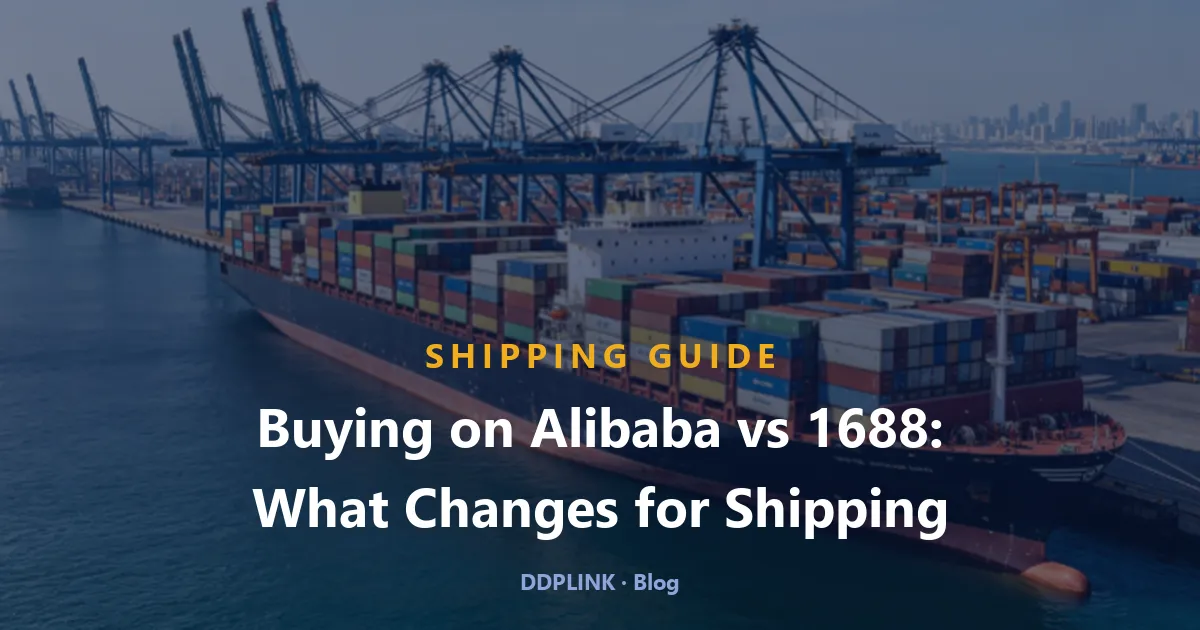

Alibaba vs 1688, compared on the shipping side: what changes in export documents, consolidation, rates and landed cost when you buy from either platform.
Choosing between Alibaba vs 1688 shipping is not a price comparison. It is a decision about who exports the goods, which documents will exist, when the cargo can leave China, and who recovers the tax afterwards. Most buyers compare unit prices and stop there, then meet the rest of the difference at the warehouse.
This guide covers the shipping side: what the platform changes before freight is quoted, and what it changes inside the quotation.
Alibaba vs 1688: What Changes Once You Choose a Platform
Both platforms list the same factories. They were built for different buyers, and that difference is exported into your shipping file.
| What it affects | Buying on Alibaba.com | Buying on 1688.com |
|---|---|---|
| Price basis | Export price in USD; sales, documentation and export costs sit inside the number | Domestic wholesale price in RMB with no export service attached |
| Incoterm you are quoted | EXW, FOB or CIF, occasionally DDP | Domestic delivery to a Chinese address, nothing past it |
| Export declaration | Usually prepared by the seller or the seller’s agent | Usually not the seller — it falls to a forwarder, a buying agent or a trading company |
| Documents | Commercial invoice, packing list, sometimes a certificate of origin | At most a domestic sales document; export paperwork is created downstream |
| Shipment shape | Usually one seller, one booking, sometimes one container | Several sellers, several parcels, one consolidated shipment |
| When the schedule starts | At the seller’s cut-off | When the last parcel reaches the consolidation warehouse |
Neither column is automatically better. The Alibaba price carries a margin that pays for English sales staff, documentation and a logistics desk; on 1688 you buy at a domestic price and assemble those services separately. The question is whether you can absorb four changes: who exports, what documents exist, how the cargo consolidates, and how the landed cost is structured.
MOQ sets the tone. An export listing often asks 100 to 1,000 units while a domestic listing may open at 10 to 100, so a 1688 order is more often many small parcels than one pallet.
Domestic Delivery Price vs a Quoted FOB Price
The most useful distinction is what the quoted number covers. A 1688 quote ends at a Chinese address; an Alibaba FOB quote ends at a Chinese port with the export declaration already made.
| Covered by the quoted price | 1688 domestic price | Alibaba FOB price |
|---|---|---|
| Goods delivered to | A Chinese address you nominate | A named port or terminal in China |
| Inland trucking in China | Yours, usually small | The seller’s cost, inside the FOB price |
| Export declaration | Normally not included | Included through the seller’s export agent |
| Loading to vessel or aircraft | No | Yes, up to the FOB point |
| International freight | No | No under FOB, yes under CIF |
| Destination clearance and delivery | No | No |
That difference moves your first shipping decision earlier. On 1688 you choose the receiving city, which decides the port, the airport and how much inland trucking you pay. Cargo sourced around Yiwu moves naturally through Ningbo, Guangzhou orders hand over at Nansha or Shekou, Shenzhen suppliers at Yantian.
Our consolidation warehouses sit in Shenzhen and Shanghai. The China departures overview lists the cities most of this cargo starts from, and Yiwu sourcing has its own receiving pattern in the Yiwu shipping guide. For inland suppliers in Zhengzhou or Chengdu, expect two to five days of domestic delivery and a truck cost that scales with parcel count — a real line on a 1688 order, a rounding error on an FOB order.
Export Rights, the VAT Invoice and Who Appears on the Declaration
This is where a cheaper purchase can turn into a slower shipment.
Who is allowed to declare an export
Under Chinese customs rules an export declaration is made by a consignee or consignor registered with Customs, or by an authorised broker acting for one. Registration is a formal step: the enterprise files with its local Customs and holds foreign trade operator registration, as the General Administration of Customs sets out in its guidance on registration of a consignor of exported goods. A 1688 store selling into the domestic market all week often has no reason to hold that registration.
So a 1688 order leaves China through one of three arrangements. Know which one you are in before paying a deposit.
| Route | Exporter on the declaration | What you receive | Where the friction sits |
|---|---|---|---|
| The seller exports (most Alibaba sellers, some 1688 stores) | The seller or its export agent | Commercial invoice and packing list in the seller’s name | Lowest — the seller’s system is built for export |
| Your forwarder or buying agent exports | The forwarding or trading company | Invoice issued by that company, declaration copy on request | The invoice names a company you never ordered from, which some banks and customs regimes question |
| You export through your own Chinese entity | Your entity | Full document set in your name | You carry the tax filing and compliance work |
The invoice question, and why it changes the net saving
China’s export tax rebate is calculated from input VAT evidence: for a trading enterprise the refundable amount is the figure on the VAT special invoice multiplied by the rebate rate, as the Shanghai government’s export tax rebate FAQ sets out. A domestic seller who will not issue a special VAT invoice puts that recovery out of reach for whoever exports, so part of the headline gap between a 1688 listing and an Alibaba listing is not a discount at all.
That is not a reason to avoid 1688. If you source through an agent, ask who the exporter of record will be and which invoice you will receive.
Our Industry Insight: The documentation failure we see most often on these orders is not a missing HS code. It is a declaration and an invoice naming different operators, with a packing list matching neither. Buyers discover it at destination, when an entry already exists in someone else’s name. Writing the three names — supplier, exporter on the declaration, invoiced party — into the order email prevents the whole class of problem.
The same rule shapes paperwork under sea freight: the bill of lading consignee, the commercial invoice and the declaration must describe one continuous transaction.
Consolidation: How Several 1688 Sellers Reset Your Schedule
A single Alibaba shipment has one cut-off. A 1688 order usually has four or nine parcels arriving over one to three weeks, each with its own domestic tracking number, so the last arrival sets the departure date.
The free storage window is a scheduling tool
Consolidation warehouses in China normally hold cargo free for about 30 days, and some agents advertise 60 days or more. Read that as a scheduling instrument rather than a perk: it states how long you can wait for the stragglers before the shipment costs you storage or a second departure.
| Situation at the warehouse | What it costs | Practical decision |
|---|---|---|
| All parcels arrive within a week | Nothing extra | Hand over documents and book the departure your stock plan needs |
| One parcel is 10–20 days behind, inside the free window | Waiting time only | Hold the consolidation and sail once; fixed costs stay single |
| A parcel falls outside the free window | Storage fees, or a second shipment with its own documentation, handling and delivery charges | Ship what you have and send the remainder separately |
| Stock is confirmed but no carton data exists | Quotation uncertainty | Ask for carton dimensions with the goods, not after |
Documentation, handling, destination clearance and final delivery repeat with every departure, so two smaller shipments frequently cost more than ten days of patience.
Our Industry Insight: The last parcel decides the schedule in roughly one 1688 consolidation in three, and it is usually the cheapest line in the order — the hardware sample, the packaging, the accessory nobody chased. We confirm the arrival status of every parcel in writing before quoting a sailing date, because a buyer told “your shipment is booked” who then waits a fortnight planned around a date nobody could hold.
Measurement and repacking change the price you pay
Suppliers pack for Chinese domestic freight, not for an aircraft. The warehouse re-measures every carton, and volumetric weight decides the bill on light goods: air freight divides by 6,000, express by 5,000.
| Carton as packed | Dimensions | Actual | Volumetric, air ÷6,000 | Chargeable by air | Volumetric, express ÷5,000 | Chargeable by express |
|---|---|---|---|---|---|---|
| Dense goods | 60 × 40 × 40 cm | 32 kg | 16 kg | 32 kg | 19.2 kg | 32 kg |
| Mixed goods | 60 × 40 × 50 cm | 15 kg | 20 kg | 20 kg | 24 kg | 24 kg |
| Bulky, light goods | 80 × 60 × 60 cm | 8 kg | 48 kg | 48 kg | 57.6 kg | 57.6 kg |
The third row ruins budgets: eight kilograms of goods billed as fifty or more because the seller used a display carton. Consolidating parcels into fewer, denser cartons is often worth more than negotiating the rate. The volumetric weight calculator runs the same arithmetic on your own dimensions.
Choosing the Mode Before You Have Final Carton Data
Buyers often wait for exact carton data before choosing a mode, then find the sailing they wanted is full. The mode is set by value, density and deadline.
| Mode | Priced by | Practical range from China | Typical transit | What must be true before booking |
|---|---|---|---|---|
| Express courier | Chargeable kg, banded | Up to about 45 kg | 2–7 days | Contents described accurately; batteries and liquids declared |
| Air freight | Chargeable kg, by weight break | From about 45–100 kg upward | 3–7 days | Carton data confirmed and documents complete |
| Sea LCL | Per CBM, minimum 1 CBM | From 1 CBM | 15–45 days by route | Goods can share a container; full packing list |
| Sea FCL | Per container | From roughly 13–15 CBM | 20–40 days port to port | Enough volume for a box; loading plan agreed |
| DDP air or sea | All-in per kg or CBM | From small parcels upward | 5–9 days air, 18–45 days sea | Declared value and product details accepted before booking |
Can a consolidated marketplace order go DDP?
Yes, and for many 1688 buyers it is the simplest structure: one price covering pickup from several suppliers, consolidation, export declaration, freight, import clearance, duties per the agreed terms and delivery to the address you name. Our DDP shipping service collects from multiple factories and combines them into one consignment, which avoids running a separate clearance file per seller.
Two caveats. DDP does not remove duty — it collects it inside the price, and since 29 August 2025 the United States applies duty to commercial shipments regardless of value, so “small enough to be duty free” is no longer true. And a customs entry still names an importer of record, a legal role carrying responsibility for classification, value and origin.
For parcels and samples, express courier is the right first shipment on both platforms: it tests a supplier’s packing and documentation on a consignment small enough that a mistake stays cheap.
Reference Rates for the Same Shipment by Mode (Q3 2026)
These bands come from the same lane data as our service pages, cut off in mid-September 2026; every rate is confirmed at booking against the space held.
| Mode, China to US | Reference rate | Typical transit | Notes |
|---|---|---|---|
| Express courier | About $6.50–$12 per chargeable kg | 3–7 days | Contract rates; fuel surcharge added monthly |
| Air freight | About $3.50–$7.50 per kg by weight break | 3–7 days | Cheaper per kg from 300 kg upward |
| Sea LCL | $325–$442 per CBM | 17–38 days | Destination handling is charged per shipment |
| Sea FCL, 20ft | From about $880 | 17–35 days | Best per-unit cost once volume suffices |
| DDP air | From $7.57/kg above 100 kg | 6–8 working days | All-in; duties per the agreed terms |
| DDP sea | From $1.28/kg above 300 kg | About 40 days | Plus a destination delivery fee on most lanes |
The pattern holds elsewhere with different numbers: express runs about $5.50–$12/kg into Europe, air about $5.50–$10.50/kg into South America, and sea LCL from $80–$110 per CBM into the Gulf to $430–$620 into Brazil. The freight cost calculator applies the same bands to your weight or CBM.
Landed Cost: Alibaba Route vs 1688 Route
Here is the comparison buyers are actually making, written as cost lines instead of per-unit prices, for a 1,000-unit order shipped by sea to a US address.
| Cost line | Alibaba route (FOB Shenzhen) | 1688 route (agent plus consolidation) |
|---|---|---|
| Goods, same specification | Higher unit price; export services inside it | Lower domestic unit price, settled in RMB |
| Sourcing agent or buying service | Not applicable | 5–10% of goods value, or a flat fee per order |
| Domestic freight in China | Inside the FOB price | Charged per parcel, several parcels |
| Export declaration and documents | Seller’s export agent | Yours, through the forwarder or a trading company |
| Consolidation, repacking, labelling | Not normally required | Warehouse handling on the consolidated shipment |
| Main freight | You book under FOB | Quoted with the consolidation |
| Duty and import taxes | Yours | Yours, or settled inside a DDP price |
| Export tax recovery | Not your claim | Available only if a special VAT invoice reaches the exporter |
The last row is where the arithmetic gets honest. The gap between the platforms is real, but on the 1688 route you pay for work that was previously bundled, and part of the theoretical saving depends on documents many domestic sellers never produce. Buyers who compare the first line alone are the ones who get surprised.
Duty, valuation and the $800 assumption
US duty comes from the classification and the declared value, not from the platform. Since 29 August 2025 de minimis duty-free treatment no longer applies to goods of any country valued at or below $800 entering the United States, as US Customs and Border Protection explains in its guidance on Executive Order 14324 — commercial parcels now enter and pay duty at every value. A declared value must also reflect the real transaction: a lower number invented to reduce duty is a liability carried by the importer of record.
In the European Union, consignments at €150 or less are declared through the Import One-Stop Shop, the EU’s own IOSS portal. Destination rules differ widely — Brazil stacks federal and state taxes and needs an importer registration a first-time buyer rarely holds — which is why our Brazil shipping guide and USA shipping guide show the tax picture before the freight line.
Where 1688 Consolidations Actually Fail
Most of what goes wrong goes wrong in China, while the goods are still reachable.
- Retail packaging as shipping packaging: thin cartons and gift boxes survive domestic courier handling and not much else.
- Phantom stock and prepayment: some listings advertise volume the seller does not hold. Paying after the goods are physically counted is standard protection.
- Cargo that cannot travel together: odours, liquids, powders and food cannot share a container with textiles or electronics, and batteries need a test report and safety data sheet before a carrier accepts them.
- Carton marks and packing lists that disagree: a warehouse that cannot match a carton to a line delays the whole consolidation.
- The returns window that closes at sailing: inspection and exchange are only possible while the goods are in China.
- Peak-season space: capacity tightens from September, and a consolidation that slips two weeks in November does not arrive two weeks late.
Real-Life Scenario: A four-supplier 1688 order we handled was three parcels short of complete for nineteen days; the last carton moved only after we called the supplier directly in Mandarin. Two earlier cartons arrived crushed, so the warehouse photographed them, repacked both into one denser carton and remeasured before quoting — the repack shaved several kilograms of volumetric weight and the photographs settled the supplier claim without a return. The buyer’s lesson was the schedule: the sailing moved twice because the order completed late, not because the sea freight was slow.
Consolidation discipline is what our case work tends to hinge on: the real shipment case studies all turned on carton data and documents settled before departure.
FAQ
Does 1688 ship internationally?
Not as a platform service. Listings are built for domestic delivery to a Chinese address, so the international leg is arranged by you, by a buying agent or by a forwarder.
Can I buy on 1688 without an agent?
Browsing and contacting sellers is possible; paying in RMB and receiving goods at a Chinese address reliably is the hard part. Most overseas buyers use an agent or forwarder for exactly those two functions.
Is 1688 cheaper than Alibaba once everything is counted?
Often, but the difference is smaller than listing screenshots suggest and it depends on order size. Agent fees, domestic freight and consolidation weigh heavily on small orders.
Do I need export documents from the seller?
On most 1688 orders the seller will not produce them, because domestic sellers are usually not registered to declare exports. The declaration runs through your forwarder, a buying agent or a trading company.
Can consolidated 1688 cargo go to Amazon FBA?
Yes. Labels, packing slips and a receiving appointment can be arranged before departure, and consolidating first is often cheaper when several suppliers contribute.
How long does shipping from 1688 take end to end?
Add collection to the transit: domestic delivery takes two to five days per parcel, the consolidation window adds days or weeks, and then express runs 2–7 days, air 3–7 days and sea 15–45 days.
Conclusion: Decide the Platform With the Shipping Math in Front of You
The platform decides four things before any freight rate exists: who exports the goods, which documents will exist, how long the cargo takes to assemble, and which costs are already inside the price you were quoted. Alibaba bundles those services into its unit price; 1688 leaves them to you and rewards you when order sizes absorb the fixed costs.
If you are comparing the two routes on a specific product, send us the supplier locations, carton counts, delivery address and order volume — we will quote the consolidated door-to-door structure and show which cost lines change between the platforms.
More articles
Air Shipping from China to Kuwait: 2026 Rates, Transit & Clearance
Air shipping from China to Kuwait in Q4 2026: rates by weight break into KWI, transit via Dubai and Doha, KUCAS clearance, and 5% duty with no VAT.
Read Article →
Air Shipping from China to Nigeria: 2026 Rates & Transit
Air shipping from China to Nigeria in Q4 2026: rate bands into Lagos, Abuja and Kano, chargeable weight, the Form M and SONCAP clock, and what happens at MMIA.
Read Article →
Air Shipping from China to South Africa: 2026 Rates, Transit Times & Clearance
Air shipping from China to South Africa in 2026: rates by weight break, transit to Johannesburg, Cape Town and Durban, and the SARS duty and 15% VAT stack.
Read Article →