


 USA
USA Canada
 Mexico
 Brazil
 UAE
UAE Saudi Arabia
 Iraq
Iraq Nigeria
 Ghana
Ghana Côte d’Ivoire
 Kenya
Kenya Uganda
 Tanzania
 DR Congo
 Angola
 South Africa
 UK
UK Germany
 France
 Netherlands
 Spain
Spain Australia
How Long Does Shipping Take from China to Brazil? (2026 Transit Times)
September 28, 2026
← All Articles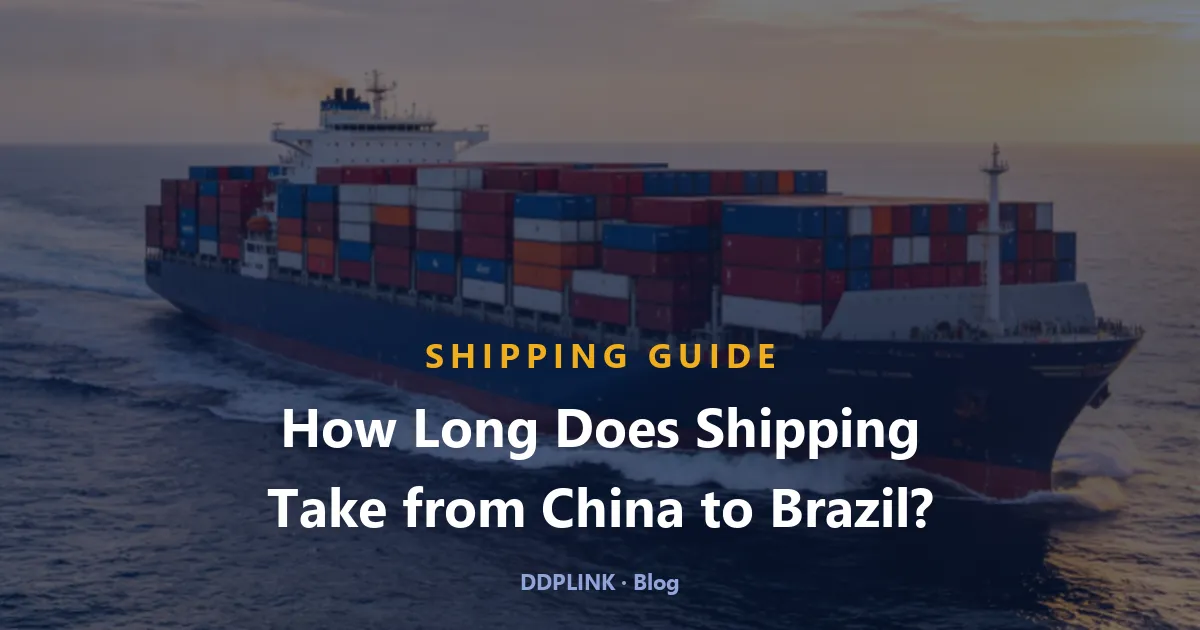

Shipping time from China to Brazil in Q4 2026: sea, air, express and DDP bands for Santos, Paranaguá, Manaus and São Paulo, plus the Receita Federal clock.
Shipping time from China to Brazil is two numbers, not one. A Ningbo sailing reaches Santos in 32–42 days, but a São Paulo warehouse usually sees the container at 40–55 days, because the slow part of this lane is not the ocean — it is the queue after discharge.
A forwarder’s schedule stops at the quay. Your stock date stops at your door. This guide uses the Q4 2026 figures behind our shipping from China to Brazil guide, labels every band by where its clock starts and stops, and shows why an eight-digit NCM code and your buyer’s RADAR registration move a delivery date more than any vessel does.
Quick Answer: How Long Does Shipping Take from China to Brazil? (Q4 2026)
These are door-to-door planning bands for general cargo in the Q4 2026 market.
| Method | Door-to-door transit (Q4 2026) | What the clock includes | Best for |
|---|---|---|---|
| Express courier | 5–10 days | Pickup, flight, Brazilian clearance and delivery under one tracking number | Samples and parcels up to about 45 kg |
| Air freight (airport to airport) | 5–8 days CAN–GRU; 6–10 days HKG–GIG | Flight and terminal handling only | Buyers with a despachante already appointed |
| Air freight under DDP | 8–12 days | Pickup, flight, DUIMP clearance, taxes per agreement, delivery | Urgent stock, electronics, spare parts |
| Sea FCL (port to port, Santos) | 32–42 days | Ocean transit and discharge only | Containers with a Brazilian broker lined up |
| Sea FCL under DDP | 40–55 days | Pickup, vessel, clearance, taxes per agreement, delivery | Machinery, furniture, bulk cargo |
| Sea LCL under DDP | 40–55 days, often the top of the band | Sailing plus consolidation in China and deconsolidation (desova) at Santos | Part loads from about 1 CBM |
II, IPI and ICMS sit outside these bands unless you book DDP, where they are inside the price. Parcels travel with express courier from China; anything heavier is a weight-break decision.
Sea Freight Transit Time from China to Santos, Paranaguá and Itajaí
Published numbers spread widest on this lane: the same port pair appears as 26 days on one site and 45 on another, because one figure is a direct sailing and the other includes a relay and the terminal queue. Our Q4 2026 windows are 32–42 days into Santos, 34–44 into Paranaguá and 36–46 into Itajaí–Navegantes; rates below are freight only.
| Route (port to port) | Ocean transit | 20ft FCL | 40ft FCL | LCL |
|---|---|---|---|---|
| Ningbo → Santos | 32–42 days | $2,350–$3,250 | $4,480–$5,860 | $430–$520/CBM |
| Shanghai → Itajaí | 36–50 days | $2,680–$3,680 | $4,980–$6,450 | $520–$620/CBM |
Santos handles roughly 40% of Brazil’s containers and is the default gateway for São Paulo state and the Center-West; Paranaguá suits general cargo and agribusiness; Itajaí–Navegantes serves southern importers. Details sit on the sea freight from China service page. Southern China loadings out of Yantian and Shekou sail on a different weekly string, which is one reason two quotes for "Santos" can differ by a week. Much of our Brazil cargo books out of Shenzhen.
FCL vs LCL: Where the Extra Three to Eight Days Come From
FCL keeps your cargo in a box nobody else touches, so the clock is the sailing plus terminal handling. LCL adds two windows: consolidation in China, where your pallets wait until the container fills, and deconsolidation at a Brazilian CFS, where the box is stripped before individual declarations are released. Each runs two to four days in a normal week.
Direct Sailings vs Transshipment: Two Weeks Hiding in One Quote
Two quotes for one port pair can differ by 10–14 days with neither being wrong. Direct calls from Yantian, Shanghai or Ningbo to Santos are the benchmark; relays through an intermediate hub add a discharge and a reload, and secondary ports such as Itajaí or Rio Grande depend on those relays. Ask which routing a quote is built on before you compare prices.
Air Freight Transit Time from China to São Paulo and Rio
Air freight answers the question sea cannot: how do I get goods onto a shelf this month? Our band is 5–8 days airport-to-airport from Guangzhou to São Paulo and 6–10 days from Hong Kong to Rio, or 8–12 days door to door under DDP. Rates below are freight and origin charges, before Brazilian duty, ICMS or delivery.
| Chargeable weight | CAN → GRU (5–8 days) | HKG → GIG (6–10 days) |
|---|---|---|
| 100 kg | $1,680–$2,160 | $1,760–$2,280 |
| 300 kg | $3,520–$4,560 | $3,680–$4,780 |
| 500 kg | $5,300–$6,850 | $5,520–$7,150 |
| 1,000 kg | $9,900–$12,800 | $10,300–$13,300 |
Scheduled China–Brazil freighter capacity is thin, so most consignments connect through one or two hubs. Service detail is on the air freight from China service page.
Chargeable Weight Decides Your Departure Date, Not Just Your Invoice
Airlines bill the greater of actual and volumetric weight — length × width × height in centimeters divided by 6,000 — and bulky cargo is rolled first when space tightens. Run the carton dimensions through the volumetric weight calculator before requesting space: cargo that looks like 300 kg and bills at 700 kg can wait for a later departure.
Shipments to Manaus: The Extra Leg Few Quotes Mention
Manaus is the one Brazilian destination where the transit answer changes shape. The city sits about 1,500 km up the Amazon, so cargo either clears on the coast and moves inland or enters the Manaus Free Trade Zone under the SUFRAMA regime. Our published window is 40–50 days by sea, eight to twelve days beyond Santos, on a thinner schedule with fewer weekly options.
| Gateway | Q4 2026 window | What adds the days | Preparation that matters |
|---|---|---|---|
| Santos or Paranaguá to Manaus | 40–50 days | Amazon water leg plus a longer inland connection | SUFRAMA registration and a complete file before sailing |
| Air to Manaus (MAO) | 8–14 days door to door | Most consignments clear on the coast and finish on a domestic flight | Confirmed import regime; air does not bypass the free zone paperwork |
The tax incentives are real for electronics, appliances and motorcycles, but goods need the correct regime on entry and an incomplete file costs days at the terminal. Exporters usually find ANVISA approvals the long-lead item, and our DDP service handles the Manaus routing.
The Door-to-Door Ledger: Where 45 Days Actually Go
Below is a clean 20ft shipment from a Zhejiang supplier to a São Paulo warehouse, built from our Q4 2026 working figures.
| Stage | Typical days | Clock starts when | Controlled by |
|---|---|---|---|
| Supplier pickup, export declaration, loading | 1–2 | Cargo-ready date | Us, with your supplier |
| Cut-off to vessel departure | 0–4 | Booking cut-off | Carrier schedule |
| Ocean transit to Santos | 32–42 | Sailing date | Carrier and routing |
| Discharge and container availability | 2–5 | Vessel arrival | Terminal and port authority |
| Receita Federal clearance under DDP | 1–5 | Discharge or pre-arrival filing | Us, with the despachante |
| Inland move to the São Paulo warehouse | 0–2 | Container release | Us |
| Delivery appointment and unloading | 0–1 | Arrival at your address | You |
Typical values land inside our published 40–55 day DDP band; adding the worst case of every row gives a number no shipment experiences. What DDP buys is not a faster vessel — it is that clearance and delivery stop waiting on another desk.
Real-Life Scenario — the LCL that took 47 days against a 35-day quote. A southern Brazil importer ordered 6.5 CBM of small appliances from Foshan in July 2026 on a quoted 35-day transit. The box waited four days for the container to fill in Shenzhen, sailed 34 days to Santos, spent two days in discharge and three in deconsolidation at the CFS, then ran six days on a yellow channel because the NCM on the invoice did not match the code filed in the declaration. It landed at 47 days door to door — inside our 40–55 day LCL DDP band, twelve days past what the buyer had planned.
Counting Backwards from a Fixed Shelf Date
Planning works better in reverse. Take Black Friday in Brazil, the country’s biggest e-commerce date: stock must be in a São Paulo warehouse by Monday 23 November 2026 to be pickable for Friday 27 November.
| Step (counting backwards) | Date window | Why it sits there |
|---|---|---|
| Arrival and discharge at Santos | 16–18 November 2026 | A 32–42 day ocean leg from an early-October sailing |
| Container available and cleared | 18–21 November 2026 | Terminal release plus one to five clearance days |
| Inland move and warehouse delivery | 20–23 November 2026 | One to two days on the road, plus an appointment |
| Sailing from Ningbo | 5–15 October 2026 | Counting back the ocean leg |
| Documentation cut-off | 1–12 October 2026 | Three to four days before loading |
| Cargo ready at the factory | 28 September – 10 October 2026 | Production must finish here |
| RADAR confirmed, LI approved where required | September 2026 | Import licensing runs weeks, not days |
Two dates are easy to miss. The first week of October is the Chinese National Day holiday, so a cut-off in that week slips. And the last sailing that still lands before Black Friday leaves China in mid-October.
The Inland Leg: Santos to São Paulo, Curitiba and Beyond
A "32–42 day" Santos transit answers a port-to-port question. Deliver 90 km away and the extra time is small; deliver 1,200 km south and it is not.
| Inland leg from Santos | Distance (approximate) | Typical days | What decides it |
|---|---|---|---|
| São Paulo metro and ABC belt | 90–100 km | 0–1 | Terminal gate, city congestion, delivery window |
| Campinas, Jundiaí, Sorocaba | 200–250 km | 1 | Release time, factory appointment |
| Curitiba | 400–420 km | 1–2 | Truck availability, load planning |
| Belo Horizonte | 580–620 km | 1–2 | Truck availability, state border formalities |
| Porto Alegre | 1,150–1,250 km | 2–3 | Distance and load planning |
| Brasília, Goiânia | 1,000–1,200 km | 2–3 | Distance and driver hours |
Santos also operates terminals on both banks of the estuary, and which one your box discharges at decides the gate it leaves by. The pattern we see most often is not a slow road but an empty one: release lands late on a Friday, no truck is pre-booked, and a two-day leg becomes four.
Our Industry Insight: We pre-book the inland truck against the expected release date and re-confirm it when the clearance channel is assigned, because trucking capacity in São Paulo state tightens at month end. It is a cheap step that protects the part your customer actually sees.
Clearing Receita Federal: What the Siscomex Channel Costs in Days
Clearance is the largest single variable in a Brazil transit plan, and it is assigned, not negotiated.
| Channel | What happens | Typical air timeline | Typical sea timeline |
|---|---|---|---|
| Green | Automatic release after tax payment | Same day to 1 day | 1–2 days after availability |
| Yellow | Document review, no physical inspection | 2–5 days | 2–5 days |
| Red | Document review plus physical inspection | 5–15 days | 5–15 days |
| Grey | Red-channel procedure plus a valuation analysis | 15 days and up | 15 days and up |
What changes your delivery date is when the declaration is registered. A DUIMP filed while the vessel is still at sea can be assessed before the container is available, so a green channel costs hours rather than days; filed after discharge, the clock starts late. The Receita Federal portal publishes the rules and the DI-to-DUIMP schedule, and the Portal Único Siscomex carries the habilitação services a Brazilian broker works from.
Three things move a shipment from green to yellow or red, and none are about speed. RADAR habilitação that is inactive or exhausted, because only a company registered in Siscomex with a CNPJ can be the importer of record. An import license (LI) required for the NCM and not yet approved. And an NCM mismatch between invoice, packing list and declaration, where one wrong digit changes the duty rate, the agency involved and the channel.
Storage turns days into money: Santos terminal free time is measured in days, not weeks, so a red-channel inspection running across a weekend is billed for the weekend. Run classifications through the China HS code lookup and let the Brazilian despachante confirm the NCM before the cargo leaves.
Our Industry Insight: We confirm the buyer’s Siscomex status and licensing position before booking space, not after the container is on the water. A container waiting for an LI at Santos accumulates storage and a missed shelf date; the same container waiting at the factory costs a phone call.
Peak Season and Holiday Effects on Transit Time
Seasonality works in both directions: Chinese factory and space cycles at the origin, Brazilian retail and port cycles at the destination.
| Period | Effect on shipping time | Buffer to build in |
|---|---|---|
| January–February (Chinese New Year and Carnaval) | Factories close one to three weeks, and Carnaval slows Brazilian ports, banks and trucking in the same window | Plan a two to three week buffer; order before late January |
| April–June | The softest rates and the calmest booking window of the year | Book FCL space early; start licensing that needs lead time |
| September–November (Brazil’s export harvest peak) | Coffee, sugar and grain exports compete for Santos berths and trucks | Expect one to three extra days at anchorage and inland |
| October (Golden Week, first week) | Chinese handling capacity drops; a cut-off in that week slips | Move the cut-off into the last week of September |
| November–December (Black Friday and Christmas) | E-commerce stock must clear customs by early November; December working days shrink in both countries | Ship November cargo in early October; mid-October is the last useful sailing |
Storms in the South China Sea and the Brazilian rainy season from December to March can each add a couple of days. The weeks when rates are soft are the weeks when space and port capacity are quiet, and the weeks when everyone wants to ship are the weeks the lane is slowest.
How to Shorten the Journey: What Buys Days and What Only Feels Fast
Most of these cost little. The ranking is by days saved per unit of effort, from our own Brazil shipment history.
| Action | Days saved | Cost | When it works |
|---|---|---|---|
| Book the cut-off, not the cheapest sailing | Up to 7 | Free | Cargo-ready dates close to a weekly cut-off |
| Pre-file the DUIMP before the vessel arrives | 1–5 | Free under DDP | Every sea and air shipment |
| Confirm RADAR and start the LI before pickup | 5–15 if left late | Licensing fees | Machinery and regulated goods |
| Ship FCL instead of LCL above roughly 8 CBM | 3–8 | Higher freight | Volumes where desova stops paying for itself |
| Lock the NCM across invoice, catalog and declaration | 3–15 | Free | Every shipment, every time |
| Pre-book the inland truck against the release date | 1–3 | Same or less | Deliveries outside São Paulo metro |
Things that feel faster but rarely are: a premium "express" sailing that is the same service with a faster name, routing to Itajaí or Paranaguá to reach a São Paulo address, and flying cargo that is not needed early. Model each option on the freight cost calculator first, and remember that air freight lifts the customs value that II, IPI and ICMS are calculated on.
FAQ: Shipping Time from China to Brazil
How long does shipping from China to Brazil take?
Plan by mode. Express courier runs 5–10 days door to door, air freight 5–10 days airport to airport and 8–12 days under DDP, sea FCL 32–42 days port to port into Santos and 40–55 days door to door.
How long does sea freight from China to Santos take?
32–42 days port to port on our Q4 2026 band, with Paranaguá at 34–44 days and Itajaí–Navegantes at 36–46 days. Add two to five days for discharge and container availability, then one to five days for clearance.
How long does shipping from China to Brazil take door to door?
Budget 40–55 days for sea under DDP and 8–12 days by air under DDP. That gap is not a hedge: it is discharge, clearance, tax payment and the inland move, and on a red channel those stages alone can run two weeks.
How long does air freight from China to Brazil take?
Five to eight days airport to airport from Guangzhou to São Paulo and six to ten from Hong Kong to Rio, measured from airline acceptance. Pickup, export handling, clearance and collection sit outside those numbers, which is why we publish 8–12 days under DDP.
How long does customs clearance in Brazil take?
Green: the same day to two days after availability. Yellow: two to five days. Red: five to fifteen. Grey: fifteen and up. Pre-filing the DUIMP before arrival keeps a clean shipment in the first two bands.
What delays a China–Brazil shipment?
The recurring causes in our files: an inactive or capped RADAR status, an unapproved import license, an NCM that does not match the declaration, a valuation query, a red-channel inspection, and space shortages around Golden Week or Black Friday.
How long does shipping to Manaus take?
Sea to Manaus runs 40–50 days, eight to twelve days beyond Santos because of the Amazon leg and a thinner sailing schedule, and air lands at 8–14 days door to door because most consignments clear on the coast.
Conclusion: Planning Your Brazil Timeline
Choose the mode and half the question answers itself: express at 5–10 days for parcels, DDP air at 8–12 days for stock that cannot wait, DDP sea at 40–55 days for everything else. Then add the stages nobody quotes — cut-off, terminal release, clearance channel, tax payment and the inland leg to your address.
Send us the dimensions, weight, commodity, HS code if you have one and the delivery city, and we will return an itemized quote with freight, duty and ICMS as separate lines and each transit stage dated, as soon as possible. Request a free quote and we will map the timeline against your deadline.
More articles
Air Shipping from China to Kuwait: 2026 Rates, Transit & Clearance
Air shipping from China to Kuwait in Q4 2026: rates by weight break into KWI, transit via Dubai and Doha, KUCAS clearance, and 5% duty with no VAT.
Read Article →
Air Shipping from China to Nigeria: 2026 Rates & Transit
Air shipping from China to Nigeria in Q4 2026: rate bands into Lagos, Abuja and Kano, chargeable weight, the Form M and SONCAP clock, and what happens at MMIA.
Read Article →
Air Shipping from China to South Africa: 2026 Rates, Transit Times & Clearance
Air shipping from China to South Africa in 2026: rates by weight break, transit to Johannesburg, Cape Town and Durban, and the SARS duty and 15% VAT stack.
Read Article →